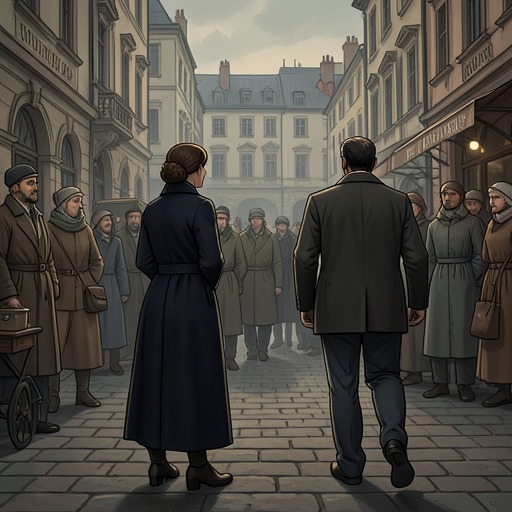
Csongor and Mirígy’s enmity
Csongor és TündeCsongor and Mirígy’s enmity is a conflict of opposing interventions: he breaks her chains and sends her away, while she turns to revenge and deception, using Tünde’s hair to try to make him mistake one woman for another. The hostility later sharpens into Csongor’s recognition of a treacherous servant and his promise to pursue the culprit. Across these episodes, their struggle is not simply a face-to-face contest; it reaches Csongor through the people and appearances Mirígy seeks to manipulate.
The encounter and its reversal
At their encounter, Csongor knocks off Mirígy’s chains. His rescue does not establish trust or reconcile them. Instead, he tells her that his arm has freed her and orders her to go wherever her feet and eyes take her. The command makes the encounter a brief, consequential separation: Csongor has released Mirígy, but he does not invite her to remain or join him. His action gives her freedom of movement, and the words that accompany it make clear that their paths are to diverge.
The reversal lies in what the rescue fails to secure. Csongor acts to end Mirígy’s confinement, yet the later scenes reveal no gratitude or durable peace between them. She responds from a position of freedom with a revenge that targets what matters to him, while he will eventually answer deception with pursuit. The relationship therefore changes shape without ending: first, Csongor’s physical intervention places Mirígy in his power; afterward, her schemes let her threaten his aims indirectly.
Revenge enacted through Tünde’s hair
Mirígy’s retaliation turns on a small, concrete object: a lock of Tünde’s hair. As the beautiful youth is overcome and dreams of happiness, Mirígy says that she cannot bear to watch. Revenge and malice drive her to damage the beautiful hair, and the lock is cut. The scene links the act of cutting to a change in purpose: the hair is not merely a token of injury but the material Mirígy means to use in a plot against Csongor.
Mirígy celebrates the acquisition of the locks and says she will cover her daughter with them. Her plan depends on Csongor seeing the hair and being deceived: she expects him to become enthralled in her daughter’s arms, after which Mirígy will rule. Thus the revenge is designed around mistaken recognition and seduction rather than a direct attack on Csongor. The plot also shows how their conflict extends through Tünde and Mirígy’s daughter: Mirígy turns another person’s appearance into an instrument for redirecting Csongor’s desire and securing power for herself.
The contrast between Csongor’s release of Mirígy and her response is especially sharp here. He frees her from chains; she uses the freed movement of her own scheme to threaten the beauty and intimacy associated with Tünde. Her plan makes Csongor’s capacity to recognize his beloved a point of vulnerability. The evidence establishes the intended deception and its hoped-for result, not whether this particular plan succeeds, so the episode’s force lies in the malice and design that Mirígy openly declares.
Csongor recognizes treachery
In a later episode, Csongor reflects on what has happened and asks whether a trap has been laid. He then considers whether the servant has been enlisted as a guilty instrument. His uncertainty turns to recognition: he concludes that this is indeed what has happened and calls the servant treacherous. He threatens death for the betrayal and declares that, though the culprit may flee, he will pursue him like a shadow.
This confrontation broadens the practical reach of Csongor and Mirígy’s enmity. The passage does not name Mirígy in Csongor’s accusation, nor does it explicitly identify the servant’s employer in these lines. It therefore supports a connection between their larger conflict and Csongor’s discovery of a plot using a servant, but not the claim that this servant is Mirígy herself or that the passage alone proves she directed him. What it does establish is Csongor’s changed position: he is no longer simply the man who freed Mirígy and sent her on her way, but a pursuer who has recognized deception and openly commits himself to chase its agent.
The structure of the enmity
The relationship is defined by a sequence of mismatched actions. Csongor first has the direct power to break Mirígy’s chains, yet that act does not control what she does next. Mirígy, in turn, avoids confronting him openly when she plots with Tünde’s hair: she aims to make him misread a scene and succumb to a deception. Later, Csongor’s answer is pursuit, a promise to follow the fleeing culprit like a shadow. Rescue, manipulation, recognition, and chase give the hostility its changing forms.
The episodes also distinguish established facts from intended outcomes. Mirígy’s revenge, the cutting of Tünde’s hair, and her plan to deceive Csongor are explicit; her claim that this will let her rule expresses an ambition, not a confirmed result. Csongor’s later recognition and threat of pursuit are likewise explicit, while the identity and fate of the servant are not settled by the quoted passage. Read together, these limits keep the conflict vivid without collapsing its different stages into a single, fully explained scheme: the evidence shows a continuing antagonism whose methods shift from release and separation to revenge by disguise and a threatened chase.